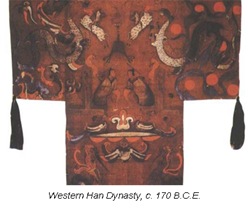
 Silk painting is a truly ancient art. Silk has been cultivated for over 3500 years, and people painted on silk well before the invention of paper. Batik cloth seems to have originated in India around the second century C.E and spread throughout Asia over the years. Batik uses wax to "resist" areas exposed to dyes, leaving the waxed areas the original color of the fabric before it's dyed. The best known examples of batik are stamped in repeated patterns.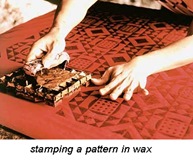
Around the fourth century C.E., Indonesian artists discovered they could use the sap of the pallaquium tree as a resist. This substance is known as gutta, a rubber-based product that can be stamped or applied in a fine line. In the past few decades, water-based resists have been 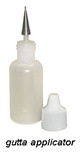 developed. To remove wax resist from a piece requires ironing it between sheets of absorbent paper; removing gutta requires dry cleaning; water-based products can simply be rinsed out with water. Thank goodness.
Just as the tradition of batik techniques vary greatly around the world, there are also many different ways to paint on silk. All the methods fall into three general categories:
 Immersion: You can immerse the fabric in a dye bath for all-over color. There are lots of ways to bind the fabric before immersing it, resulting in patterns which vary from free as tie dye to as controlled as Japanese shibori. To make the piece at right, bird shapes were stamped onto grey fabric -- then immersed in wine-colored dye.
- Direct application: By laying your fabric flat or stretching it taut, you can use a brush to paint or dye.* When you apply color to any fabric, the colors runs naturally from one fiber to
 another, creating beautiful free flowing areas of blended color (as seen on the left).
  If you want to keep the colors from spreading into each other, you must apply a finish to the surface of the silk, just as you apply gesso to a canvas. Note how the watery layers behind the sea lion do not blend into each other, but look like separate stripes?
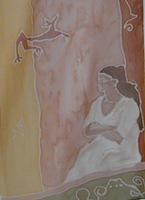
- Gutta serti: Sertir is a French verb meaning "to contain." This method emphasizes drawing, as the gutta/resist is used to outline areas of color. The dye is applied with a paintbrush, and spreads naturally over the fibers until it meets the gutta/resist line. The figures at right are surrounded by a white line, because that's where the resist was.
I use the serti method most of the time, because I like the graphic quality of the outline, but also because I think it's magic to watch the color travel from the paint brush to the resist line. 
The photo on the left shows a silk scarf stretched in my studio. Whether painting a wall hanging, yardage, or a scarf, the method is the same. All fabrics must be prewashed and ironed. I sometimes plan my design elaborately, using grid paper and a light table to enlarge it as needed. Most of the time, however, I just freehand my design directly onto the silk. I stretch the fabric on a frame and draw the design using clear resist. Once the resist has dried, I apply professional silk dyes with paintbrushes -- one in each hand and at least one in my mouth.
The process is meditative, yet immediate, since I must work quickly to keep up with the movement of the dyes. Once I'm satisfied with the painting, the color is allowed to set for a day or two. The fabric piece is then rolled in newsprint, wrapped in aluminum foil, suspended over a steam bath, and steamed for 1-3 hours. Now the piece is colorfast. After it "cures" for a day or two, I rinse out the resist lines in warm water, let it drip dry, and then iron. If the hand of the fabric has been affected by the chemicals used to mix the dyes, it gets a bath in professional fabric softener, is dried and then ironed again. 
I could go on and on. Different fabrics accept color in entirely different ways. Preparing different types of dyes involves a lot of chemistry, and each brand's chemistry is unique. Variations in humidity and altitude will affect the action of the dyes. It's difficult to mix a good brown with French dyes, and turquoise dye smells entirely different than yellow.
I think most artists are secret alchemists, loving the magic of applying color and line, whatever the surface. Being a magician is a powerful and addictive business!
____________
*Paints dry as a coating on top of the fabric; dyes bind with the fibers and become part of the fabric. Paints will affect the hand, or feel, or the fabric when they dry. Dyes do not change the hand, and the fabrics feel smooth and lush -- what people think of when they think "silk."

Instruction does not prevent waste of time or mistakes; and mistakes themselves are often the best teachers of all.


 Posts
Posts


